
THEORY
Reading the World Through Color
For Emmanuelle Moureaux, color is not decoration, but a way of reading the world.
The world is filled with infinite colors, many of which we do not yet see.
Through 色切/shikiri, her original concept of dividing and creating space with color, she treats color as a three-dimensional element that constructs space and creates emotion.
Through 100 colors, a finite chromatic system, she reveals the infinite nature of color.
01 — PHILOSOPHY The Infinity of Color
02 — CORE Color Constructs Space
03 — CONCEPT 色切/shikiri
04 — SYSTEM 100 colors
05 — METHOD CHROMAREAD
06 — IMPACT Expanding Color Perception
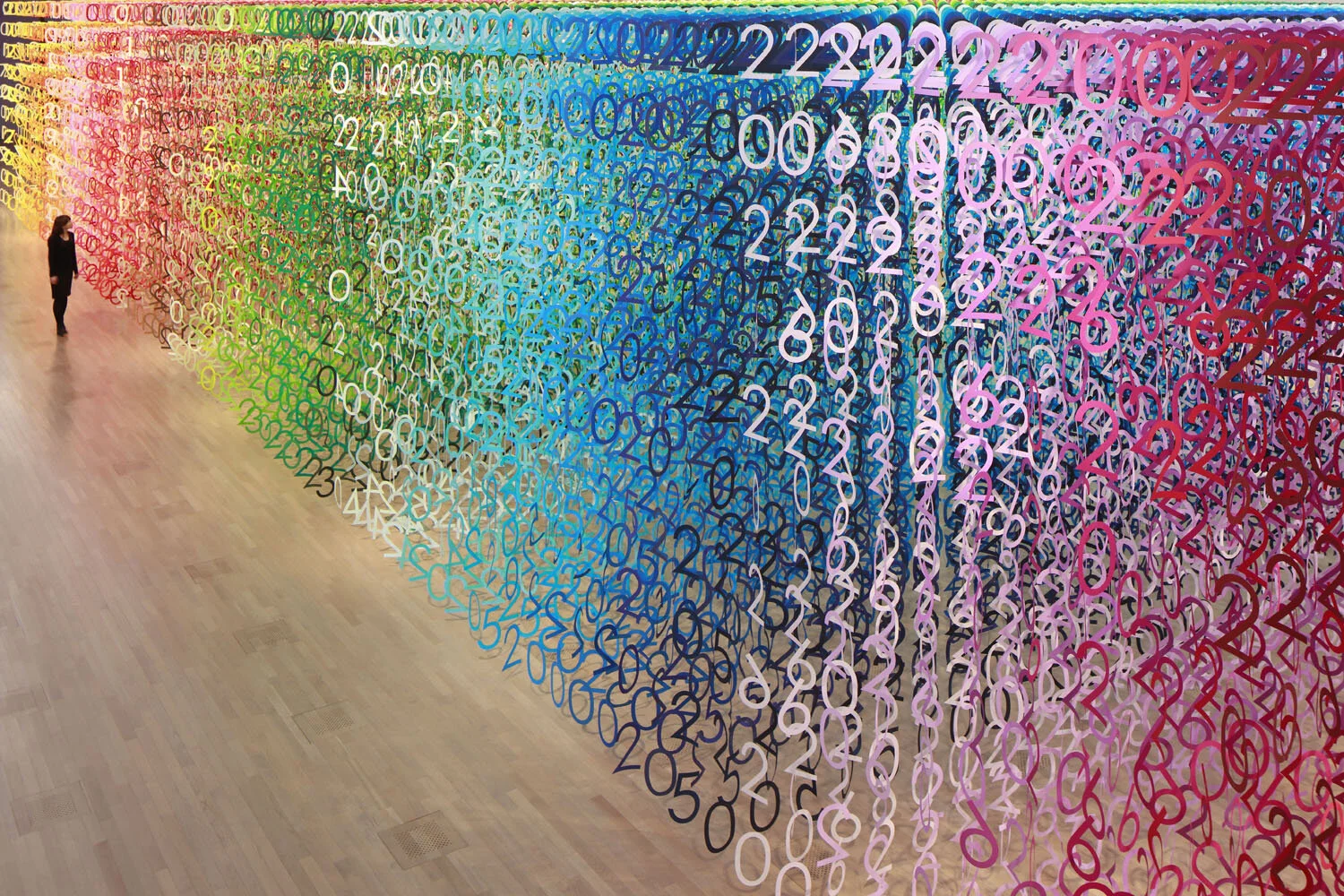
100 colors no.18 “Forest of Numbers”, The National Art Center, Tokyo, 2017.
01 — PHILOSOPHY
The Infinity of Color
Color is universal and eternal, borderless and infinite.
The world around us is filled with an immeasurable richness of color, far beyond the limited names and categories through which we usually perceive it.
Within this infinity, every color exists equally. Each color reveals itself through its relationships with others.
02 — CORE
Color Constructs Space
Color is a three-dimensional element.
Rather than being applied to surfaces as decoration, color is placed in space as layers. Through repetition, sequence, distance, and depth, color can divide and structure space.
Color is not decoration. Color is structure. Color itself creates space.
03 — CONCEPT
色切/shikiri
色切/shikiri is an original concept developed and coined by Emmanuelle Moureaux in 2003 to define the use of color as a three-dimensional element to divide and create space.
During her first visit to Tokyo in 1995, Moureaux was deeply moved by the colors overflowing through the city. She perceived them as countless layers of color floating in three-dimensional space, creating depth and density. It was as if she were seeing color for the first time.
This experience awakened her to the very existence of color and led to the development of 色切/shikiri in 2003.
The term combines the Japanese words shiki (色, “color”) and shikiri (仕切り, “dividing space”).
It expresses Moureaux’s concept of dividing and creating space with color.Instead of walls or physical boundaries, color itself divides and creates space.
色切/shikiri is the conceptual foundation of Moureaux’s entire creative practice and her way of perceiving color, space, and the world.
04 — SYSTEM
100 colors
100 colors is the chromatic system built upon a constant palette of one hundred original colors.
Since 2013, this system has unfolded through an ongoing series of installations, using the same set of one hundred colors as a constant chromatic language.
Through this finite system, every site, form, and composition reveals a different rhythm, atmosphere, and spatial narrative.
It is a finite system, but color itself is infinite. Through this finite framework, the infinite nature of color is revealed.
05 — METHOD
CHROMAREAD
Reading the infinite colors of the world.
The world around us is filled with infinite colors, many of which pass unnoticed.
In Moureaux’s practice, CHROMAREAD begins by turning attention to these colors — discovering and distinguishing subtle differences in the everyday world. Colors are collected, compared, classified, named, sequenced, constructed, and archived.
The term combines chroma, from the Greek chrōma (“color”), and read. It expresses Moureaux’s original method of reading the infinite colors of the world.
Through this process, colors that might otherwise pass unnoticed become visible, revealing a richness that was already there.
CHROMAREAD is a way of reading the world through color, and a foundation for creation.
06 — IMPACT
Expanding Color Perception
Becoming more aware of color changes the way we see the world.
Through her work, Moureaux invites people to experience color not only with their eyes, but with their entire body and senses.
Although we are surrounded by countless colors, many of them pass unnoticed. By experiencing subtle differences and relationships between colors, we become more aware of the richness, diversity, and beauty that already exist around us.
This way of thinking also extends into teaching, workshops, and public programs, where observing, discovering, naming, and experiencing color encourages people to become more aware of the colors of the everyday world.
The goal is not simply to see more colors, but to become more aware of them — and through color, to see and understand the world differently.
To perceive more colors is to perceive more of the world.
Theory
emmanuelle moureaux
Origin: 2003
Structured: September 2026